
The most likely answer is the Vermilion Bird, also called Zhu Que in Chinese or Suzaku in Japanese. In the East Asian Four Symbols tradition, the Vermilion Bird is the divine beast of the south, tied to the Fire element and the season of summer. If you encountered the phrase 'divine beast' paired with a bird and you are not sure where it comes from, this is almost certainly the one being referenced. That said, 'divine beast' and 'bird' appear in enough different mythological, cultural, and modern storytelling contexts that it is worth spending a moment to make sure you are looking at the right tradition.
Which Divine Beast Is the Bird Symbolically

Eleanor Hartwell
23 Mar 2026

What 'divine beast' and 'bird' actually mean together
The phrase 'divine beast' is not tied to one single mythology. Across world traditions, certain animals are elevated beyond ordinary creatures into sacred guardians, cosmic forces, or direct symbols of gods. A bird showing up in that role makes complete sense symbolically: birds move between earth and sky, which virtually every culture has read as a sign of divine mediation. Flight, feathers, and the ability to reach the heavens are universal markers of the sacred.
When someone asks 'which divine beast is the bird,' they are usually working from a specific framework where a defined set of divine beasts exists and one of them happens to be a bird. The East Asian Four Symbols system is the most structured and widely cited example of this, and that is the one most people are asking about. But it is also possible the question comes from Norse cosmology, Egyptian sacred animal traditions, Mesoamerican iconography, or even a modern game or story that borrows from one of those sources.
The strongest candidates: sacred birds in 'divine beast' traditions
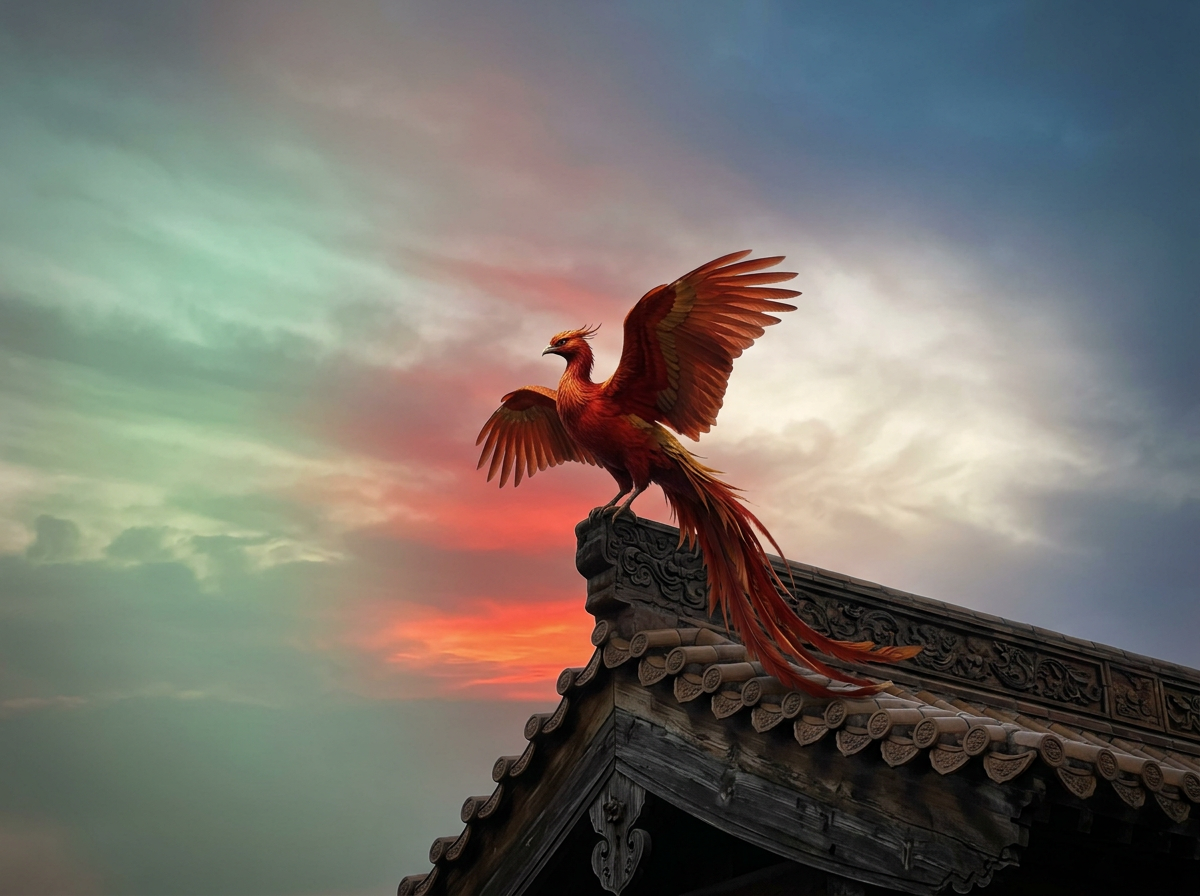
The Vermilion Bird (Zhu Que / Suzaku): the classic answer
The Vermilion Bird is the bird-form divine beast in the Four Symbols system, one of the oldest and most explicit 'divine beast' frameworks in world mythology. The Four Symbols assign a supernatural guardian creature to each of the four cardinal directions: the Azure Dragon for the east, the White Tiger for the west, the Black Tortoise for the north, and the Vermilion Bird for the south. Each is also tied to one of the Five Phases (Wu Xing): the Vermilion Bird corresponds to Fire, the south, and summer. It is depicted as a large red bird, sometimes compared to a phoenix in later popular descriptions, but its primary canonical role is as a directional guardian and elemental force, not a rebirth symbol.
Modern reference sources on yokai and East Asian spirits explicitly call Suzaku a 'divine beast,' so the terminology maps directly. If you are looking at a list of four divine beasts and one of them is a bird, it is the Vermilion Bird of the South. This is the answer for the majority of people asking this question.
Hræsvelgr: the Norse cosmic bird

In Norse mythology, a giant called Hræsvelgr sits at the northern end of heaven in the form of an eagle. Snorri Sturluson's Prose Edda describes him directly: 'At the northward end of heaven sits the giant called Hræsvelgr... when he stretches his wings for flight, then the wind rises from under his wings.' He is not labeled a 'divine beast' in the same systematic way as the Four Symbols, but he is a cosmological bird figure with enormous sacred weight. If your source is Norse, this is the bird being referenced. He also appears in fan discussions around the God of War game series as the giant bird associated with Helheim, though you should verify that against official in-game lore rather than secondary sources.
The Bennu: Egypt's solar bird
In Egyptian tradition, the Bennu bird is connected to the sun god Atum and to solar rebirth. Scholars commonly trace later phoenix mythology back to the Bennu and similar solar-bird concepts. The Bennu is not part of a 'four divine beasts' framework, but it is one of the most clearly sacred birds in any world tradition. If your source is Egyptian mythology, the Bennu is the divine bird you are looking for.
Aztec and biblical sacred birds

In Aztec tradition, the eagle is deeply sacred: the founding myth of Tenochtitlan centers on an eagle perched on a rock, devouring a snake, which priests interpreted as a divine sign from Huitzilopochtli. Separately, the quetzal bird's plumage is embedded in the very name Quetzalcoatl, and feather symbolism in Mesoamerican thought marks divine status and the ability to reach the sky. In the biblical tradition, the dove is the sacred bird most directly tied to divine presence, appearing at the baptism of Jesus as a symbol of the Holy Spirit (John 1:32), and birds appear in Leviticus purification rites as ceremonially sacred. None of these slot neatly into a 'divine beast' classification with numbered slots, but they are what you get if your source is Aztec or biblical.
How to figure out which tradition your source is using
The fastest way to narrow this down is to count the divine beasts in your source. If there are exactly four, arranged by direction or element, you are almost certainly looking at the East Asian Four Symbols system, and you are almost certainly looking at the East Asian Four Symbols system, and the bird is the Vermilion Bird of the South. If there is no clear set of four and the bird is enormous, wind-controlling, and linked to a cold or death realm, you are in Norse territory with Hræsvelgr. If the bird is solar, self-regenerating, or Egyptian in art style, look at the Bennu. If the context is indigenous Mesoamerican or Aztec, the eagle or the quetzal is the sacred bird.
| Tradition | Divine Bird | Key Markers |
|---|---|---|
| East Asian (Four Symbols) | Vermilion Bird (Zhu Que / Suzaku) | One of four directional guardians, south, fire element, red bird form |
| Norse | Hræsvelgr | Eagle-giant at heaven's north edge, causes wind, linked to death realms |
| Egyptian | Bennu | Solar bird, connected to Atum, ancestor of phoenix myths, rebirth symbolism |
| Aztec | Eagle / Quetzal | Eagle as divine omen, quetzal feathers as divine markers in Quetzalcoatl |
| Biblical / Christian | Dove | Symbol of Holy Spirit, appears at Jesus's baptism, ritual purification in Leviticus |
Why a bird makes sense as a divine beast
Across every tradition listed above, the bird earns its divine status through the same symbolic logic: it moves between worlds. Flight is the physical action of crossing from the earthly to the heavenly, and feathers are the material sign of that capacity. The Vermilion Bird rules the south through fire and warmth, both forces that rise upward. Hræsvelgr's wings generate wind, which is invisible, powerful, and untouchable. The Bennu rises with the sun. The eagle soars above human sight. The dove descends from above as a messenger.
Feathers, in particular, carry this meaning in concentrated form. In Native American traditions, eagle feathers are sacred objects tied directly to the divine. In Aztec iconography, a deity's feathered elements signal their ability to reach the sky, while serpent elements connect them to the earth. This is why birds get singled out as 'divine' across so many otherwise very different cultures: their defining physical feature is the one thing humans cannot naturally do, which is leave the ground and reach upward.
Where things get confused
The word 'divine beast' shows up in a surprising number of places beyond traditional mythology, and that is where most of the confusion comes from. The Legend of Zelda: Breath of the Wild uses 'Divine Beast' as the name for specific mechanical constructs, one of which, Vah Medoh, takes the form of a bird. If someone encountered that game and searched 'which divine beast is the bird,' they would get a different answer than someone studying East Asian mythology. Similarly, the phrase appears in various anime, trading card games, and fantasy novel series, each with their own bird-form divine creature. Similarly, the phrase appears in various anime, trading card games, and fantasy novel series, each with their own bird-form divine creature; the colossal bird shrine where there is little light.
The phoenix is another common source of confusion. Many people encountering the Vermilion Bird for the first time assume it is the same as the phoenix because both are red fire-birds. They are related in iconography but functionally different: the phoenix archetype centers on death and rebirth cycles, while the Vermilion Bird's primary role is as a directional guardian and elemental force. The Egyptian Bennu is actually closer to the phoenix in meaning. Worth knowing the distinction.
Constellations add another layer: the Vermilion Bird of the South (Nán Fāng Zhū Què) is also a Chinese constellation grouping covering a large section of the southern sky. So if you are reading an astronomy or astrology text about Chinese star lore, 'the Vermilion Bird' refers to that constellation group rather than just the mythological beast. Same name, different specific meaning depending on context.
Hræsvelgr creates its own confusion because his name translates to 'corpse swallower,' which sounds more like a death-realm creature than a wind deity, yet his cosmological function is primarily about generating wind. Discussions around the God of War game series frequently identify the large bird in Helheim as Hræsvelgr, drawing on Norse source material, but for game-specific lore you need to verify against the official in-game text rather than fan wikis or secondary summaries.
How to confirm the right answer for your specific source
Start by identifying exactly what material you are working with. If it is a book, game, show, or piece of art, note the cultural inspiration it draws from. Then use the following steps:
- Count the divine beasts: If there are four associated with directions or elements, search 'Four Symbols divine beasts' or 'Shishin' (the Japanese term) to confirm you are in the East Asian framework.
- Identify the bird's color and attributes: A red bird linked to fire and the south is the Vermilion Bird. A giant eagle linked to wind and cold is Hræsvelgr. A luminous solar bird is the Bennu.
- Search the specific work directly: For games, search '[game title] divine beast bird' to find official wiki or in-game lore. For mythology, search '[tradition] sacred bird divine beast' with the culture name included.
- Check whether the bird has a proper name: The Vermilion Bird is always named (Zhu Que, Suzaku, or a translation). If your source gives the bird a different name, search that name directly to find which tradition it belongs to.
- Look for a rebirth or regeneration theme: If the bird dies and is reborn, you are closer to phoenix or Bennu territory. If it guards a direction or generates a natural force, you are closer to the Vermilion Bird or Hræsvelgr.
For anyone researching bird symbolism more broadly across mythological traditions, it is worth noting that the question of which bird is 'most divine' connects naturally to discussions of specific sacred birds like the phoenix, the eagle, and the dove across different cultures. Related topics worth exploring include For anyone researching bird symbolism more broadly across mythological traditions, it is worth noting that the question of which bird is 'most divine' connects naturally to discussions of specific sacred birds like the phoenix, the eagle, and the dove across different cultures. Related topics worth exploring include the identity of <span>the giant bird in Helheim within Norse cosmology</span>, the symbolic role of bird gods across traditions, and how the concept of a 'bird of yore' meaning carries its own distinct symbolic weight in older textual traditions., the symbolic role of bird gods across traditions, and how the concept of a 'bird of yore' carries its own distinct symbolic weight in older textual traditions. what is the bird in helheim
The short version: if someone asks you which divine beast is the bird and gives you no other context, tell them it is the good lord bird ott india, from the East Asian Four Symbols. the good lord bird ott india Then ask what source they are working from, because the real answer depends on exactly that.
FAQ
What should I do if my text says “divine beast” but does not mention Four Symbols?
If the source does not explicitly say “Four Symbols,” the safest approach is to treat “divine beast” as a generic label and identify the specific system from context. Look for directional/element cues (south plus Fire and summer strongly point to the Vermilion Bird), then verify whether the text is listing a fixed set (like four). If the source is a modern game, the answer may be a mechanical or fictional bird rather than a mythological guardian.
How can I tell quickly whether the bird comes from the Four Symbols set or from another tradition?
Use the count and structure. When you see exactly four items that correspond to cardinal directions or elements, it usually signals the Four Symbols set. When the bird is presented as a single enormous cosmic entity with wind, storms, or the realm of the dead, it points away from Four Symbols and toward Hræsvelgr in Norse cosmology.
How do I distinguish the Vermilion Bird from the Phoenix when both are described as red fire birds?
The Phoenix and the Vermilion Bird are related by visual imagery (a fiery red bird) but their roles differ. If the text emphasizes rebirth, cycles of burning and renewal, or resurrection themes, the Phoenix or Bennu archetype may be closer. If it emphasizes a cardinal-direction guardian tied to an element and season, that is more characteristic of the Vermilion Bird.
In Chinese sources, does “Vermilion Bird” always mean the mythological guardian, or can it mean the constellation too?
Check whether the bird is associated with specific sky lore rather than a spiritual guardian. In Chinese context, “Vermilion Bird of the South” can refer to a constellation grouping in the southern sky. If the passage talks about stars, astronomy, or viewing regions of the night sky, it likely means the constellation, not the mythic beast itself.
Why do some descriptions of Hræsvelgr sound like a death creature, but the function is still about wind?
For Hræsvelgr, pay attention to the function (wind generation) and the imagery (a giant bird at the edge of heaven). The name meaning can mislead people into expecting a corpse-eating death monster, but the cosmological role is primarily wind and the atmosphere of the sky realm. If your source explicitly links the creature to death realms only, it may be a secondary interpretation rather than a direct myth reference.
If I’m reading a game or anime, how can I tell whether the “divine beast bird” is a myth reference or an original fictional creation?
If your question comes from a specific franchise or fandom discussion, assume the “divine beast” label is franchise-specific unless the work clearly cites an underlying tradition. For example, a bird-form “divine beast” in a modern game may be a construct that borrows aesthetic elements, not a direct match to East Asian, Norse, Egyptian, or Mesoamerican sacred-bird classifications.
If the source is religious rather than mythic, which sacred bird is the bird most likely referring to?
If the bird is described as a messenger that descends, delivers divine instruction, or appears in purification or sacred presence scenes, the dove archetype is often the intended “sacred bird.” If the bird is described as solar, self-rising with the sun, or tied to Egyptian sun theology, the Bennu is a better match. When you have a choice between “messenger” versus “sun rebirth,” go with the one that matches those functional descriptors.
What visual or narrative details are the best clues for identifying a bird as “divine” rather than just a heroic or ordinary bird?
If feathers are repeatedly emphasized as a sign of reaching the sky (and sometimes accompanied by deity status), that’s a strong cue for bird-as-divine in iconography. When feather details are paired with sky, flight, or mediation between worlds language, it supports identifying the intended sacred-bird archetype rather than guessing based only on color (red, gold) or size.
Next Article
The Good Lord Bird Music, Soundtrack, Songs, Quotes, Themes
Guide to The Good Lord Bird music and soundtrack: song list, quotes, themes, and when songs appear by episode.