
The Bible does not directly mention the phoenix bird as a mythological creature. If you have heard a sermon reference it, seen it in church art, or read about it in a devotional, you are encountering a long tradition of Christian symbolic interpretation, not a literal biblical text. That said, the phoenix carries real spiritual meaning for Christians, the connection to biblical themes like resurrection and renewal is genuinely powerful, and one passage in Job does use a word that some translators have rendered as 'phoenix.' Here is exactly what you need to know.
Phoenix Bird Meaning in the Bible: Christian Context

Eleanor Hartwell
23 Mar 2026

What the Phoenix Is and Where the 'Bible' Idea Comes From

The phoenix is an ancient legendary bird, not a real species. Herodotus, writing in the fifth century BCE, described it as a sacred bird from Heliopolis in Egypt that appeared roughly every five hundred years. He likened its size and outline to an eagle, described its feathers as gold and red, and said it arrived when its father died. Over centuries, the story evolved to include the phoenix deliberately burning itself to death and rising again from the ashes, embodying themes of immortality, cyclical renewal, and rebirth. If you want a deeper look at the phoenix as a mythological creature, the story itself is covered separately in what the story of the phoenix bird actually involves.
The reason people connect the phoenix to the Bible at all comes from two sources. First, early Christian writers and compilers of texts like the Physiologus (a second-century Greek text that was enormously influential on Christian symbolism) saw the phoenix's death-and-rebirth cycle as a perfect prefiguring of Christ's resurrection. Second, a single word in the Book of Job, the Hebrew word ḥōl, has been translated as 'phoenix' in some English Bible versions, creating the impression that the Bible literally names the bird. Both of these threads are worth understanding clearly.
Does the Bible Actually Mention the Phoenix?
The short answer is: maybe once, ambiguously, and almost certainly not as a direct reference to the mythological bird. Here is where to look and what you will find.
Job 29:18, the Key Passage

Job 29:18 is the verse most often cited in 'phoenix in the Bible' discussions. In this verse, Job expresses confidence that he will live long, comparing himself to something multiplying its days. The Hebrew word used is ḥōl (חוֹל), which most often means 'sand' in the Hebrew Bible. Some translations, particularly older ones influenced by rabbinic and early Christian reading traditions, render it as 'phoenix' instead. So you can open two different Bibles and read the same verse as either 'I shall multiply my days as the sand' or 'like the phoenix I shall multiply my days.' Both are defensible based on the word's range of meaning, but most modern critical scholarship and most contemporary Bible translations prefer 'sand.' The 'phoenix' reading is a legitimate interpretive tradition, but it is not the dominant one.
Acts 27:12, the Common Confusion
If you search for 'phoenix in the Bible' and someone points you to Acts 27:12, stop right there. The Greek word phoinix (φοῖνιξ) does appear in that verse, but it refers to a harbor in Crete, not the mythological bird. In many older English Bibles it is spelled 'Phenice.' The word phoinix in Greek can mean the bird, a palm tree, or a place name, and in Acts 27 it is firmly a geographic location. This has nothing to do with the phoenix legend. It is simply a port city Paul's ship considered sailing to. Any source that uses Acts 27:12 as evidence that 'the Bible mentions the phoenix' is conflating a place name with a myth.
A Quick Verification Checklist
When you see a claim that the Bible mentions the phoenix, run through these checks before accepting it.
- Is the verse Job 29: 18? If yes, check two or three major modern translations (ESV, NIV, NASB). If they say 'sand,' the 'phoenix' reading is a minority interpretive tradition, not consensus.
- Is the verse Acts 27: 12? If yes, it is a harbor in Crete. Not the bird. Move on.
- Is the source citing the Physiologus or a medieval bestiary? Those are Christian allegorical texts, not Scripture. They use the phoenix as a symbol, which is legitimate, but they are not the Bible.
- Does the source distinguish between what the Bible says directly and what Christian tradition has interpreted symbolically? If it blurs those two things, treat its claims carefully.
Phoenix Symbolism in Christianity: Rebirth, Resurrection, Renewal
Even though the Bible does not explicitly name the phoenix as a doctrinal symbol, Christians have used it as one for nearly two thousand years, and that tradition is both serious and historically grounded. The Physiologus, written around the second century CE and widely circulated throughout early and medieval Christianity, used the phoenix as a 'type' of Christ. A type in Christian theology is an earlier figure or event that prefigures something later. The Physiologus framed it this way: the phoenix dies deliberately and rises from the ashes on the third day, and this pattern argues that Christ could and did do the same. The 'third day' detail became especially important because it maps directly onto the Gospel accounts of the resurrection.
Medieval bestiaries, which were illustrated compilations of animals with Christian moral lessons, continued this tradition explicitly. One standard bestiary entry describes the phoenix dying and being 'born again from its ashes' and then interprets the bird as 'a symbol of our Lord Jesus Christ.' This language shows that for medieval Christians, the phoenix was not a pagan import awkwardly grafted onto faith. It was a recognized teaching tool, used to explain resurrection to people who might otherwise struggle with the concept of life after death.
The core symbolic meaning the phoenix carries in Christian interpretation is threefold: resurrection (death is not the end), renewal (God restores what was lost or destroyed), and immortality (the soul lives beyond the physical body). These are not invented connections. They are drawn from the mythological bird's own core themes and mapped onto Christian doctrine deliberately by early Christian thinkers.
Bible Themes That Connect to Phoenix Meaning
Even if the phoenix is not named in the Bible, the themes it represents run throughout Scripture. Here are the clearest biblical touchpoints Christians reference when using phoenix imagery.
| Phoenix Theme | Biblical Parallel | Key Passages |
|---|---|---|
| Resurrection / rising from death | Christ's resurrection as the central Christian truth | 1 Corinthians 15:20-22, John 11:25-26, Romans 6:4-5 |
| Renewal / transformation | Being made new in Christ, old self passing away | 2 Corinthians 5:17, Romans 12:2, Ezekiel 37:1-14 |
| New life from destruction | God restoring what was burned or broken | Isaiah 61:3 ('beauty for ashes'), Joel 2:25 |
| Immortality / eternal life | The promise of life beyond physical death | John 3:16, Revelation 21:4-5, 1 John 5:11-12 |
| Cyclical judgment and restoration | God bringing people through suffering into restoration | Job 23:10, Psalm 23:4, Isaiah 43:2 |
Isaiah 61:3 deserves special attention because it is the passage most organically connected to phoenix imagery. God promises to give 'a crown of beauty instead of ashes.' The ashes-to-beauty transformation is the core phoenix motif, and this verse is the closest the Bible comes to expressing that idea in direct language. It is not about a bird, but it is about exactly what the phoenix symbolizes: God taking what has burned down and turning it into something glorious. Many Christians who use phoenix symbolism anchor it here.
Ezekiel 37, the vision of the valley of dry bones, is another powerful parallel. God breathes life into bones that had no life left in them. The passage is a corporate vision of Israel's restoration, but Christians have long read it as a picture of resurrection and renewal more broadly. The structure is the same as the phoenix myth: total death, then vivid restoration by divine action.
How Christians Use Phoenix Imagery Today
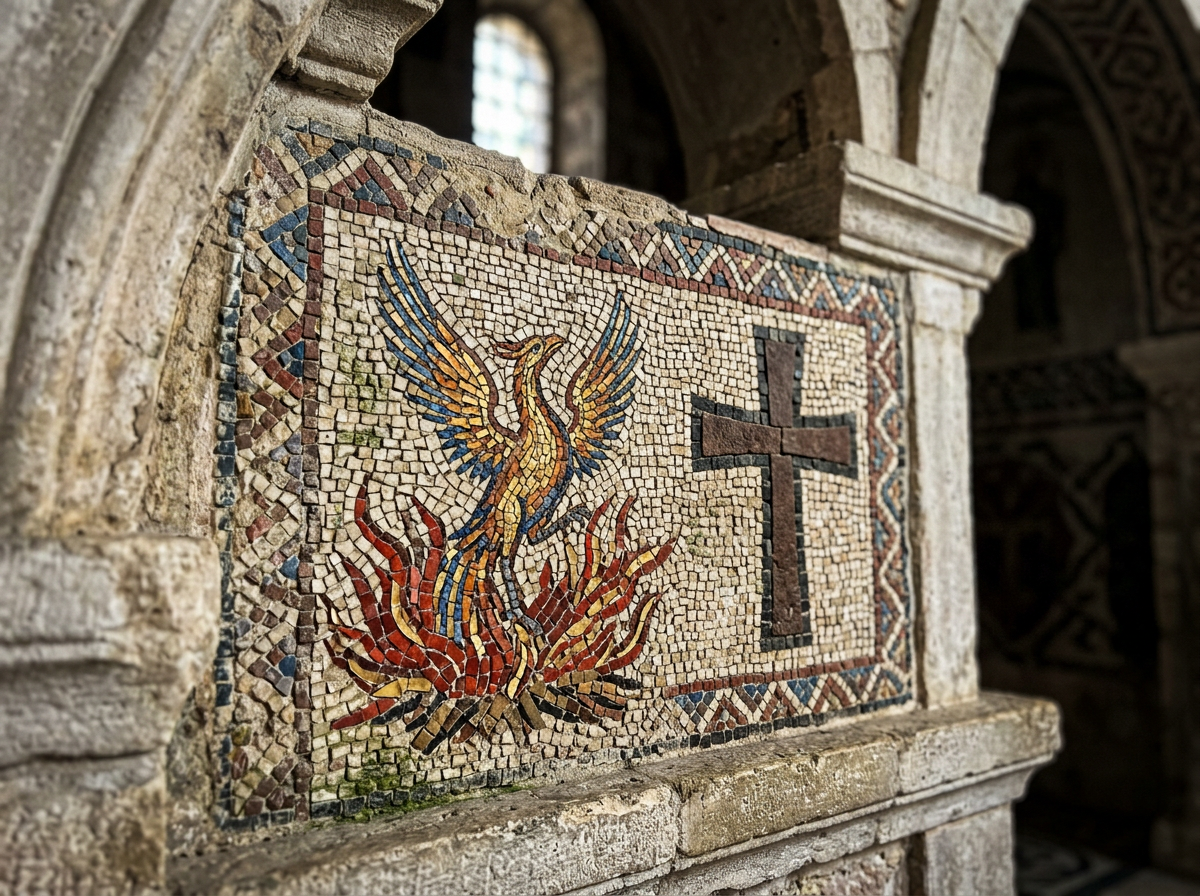
Phoenix symbolism shows up in Christian contexts more often than most people realize, and it appears in several distinct forms.
In Church Art and Architecture
Early Christian art used the phoenix as a resurrection symbol from at least the third century CE. You can find phoenix imagery in Roman catacombs, on early Christian coins, and in mosaic work from the Byzantine period. Medieval churches used it in manuscript illuminations and stained glass. The bird appears alongside Christ's resurrection imagery because it was understood to be a visual shorthand for the doctrine of life after death. If you visit a historic church and see an unfamiliar bird in flames or rising from a nest, it may well be a phoenix used in exactly this theological sense.
In Sermons and Devotional Writing
Modern preachers and Christian writers still use phoenix imagery as an analogy, and this is where readers sometimes get confused about whether the Bible 'teaches' the phoenix. It does not, but the phoenix functions as a helpful illustration. A sermon might say something like 'We are called to transformation, like a phoenix rising from the ashes,' anchoring the point in biblical texts about renewal and resurrection rather than claiming the phoenix is a biblical figure. Episcopal, Catholic, and mainline Protestant churches are particularly likely to use this kind of language, especially during Lent, Easter, and services focused on grief or life transition.
In Personal Devotion and Spiritual Reflection
For individual Christians, the phoenix can serve as a personal symbol during seasons of loss, failure, illness, or spiritual crisis. Wearing phoenix imagery, keeping it as a visual reminder, or meditating on the rising-from-ashes motif alongside passages like Isaiah 61:3 or Romans 8:28 is a legitimate devotional practice. The symbol does not have to be biblical in origin to carry spiritual meaning for a believer. Christians have always used extra-biblical images (the ichthys, the chi-rho, the anchor) as shorthand for theological truths. The phoenix fits within that tradition.
Phoenix vs. Biblical Resurrection: How the Ideas Compare

It is worth being honest about where the phoenix symbol aligns with Christian theology and where it diverges, because treating them as identical can mislead.
| Dimension | Phoenix Myth | Biblical Resurrection |
|---|---|---|
| Agent of rebirth | The bird itself, through its own action (self-immolation) | God, through divine power (not human or creature-initiated) |
| Cycle or once-for-all? | Cyclical, recurring over hundreds of years | Christ's resurrection is a singular, unrepeatable historical event |
| Who rises? | One immortal bird in perpetual renewal | All who are in Christ, at the end of the age (1 Cor. 15) |
| Purpose | Immortality and continuation of the creature | Redemption, relationship with God, transformation of all creation |
| Nature of the body | Essentially the same bird, reborn | A transformed, glorified body (1 Cor. 15:42-44) |
The phoenix is a beautiful and resonant symbol, but it is a symbol drawn from outside Scripture and applied to biblical truth. When Christians use it well, they acknowledge that distinction. The phoenix illustrates resurrection; it does not define it. The biblical account, especially in 1 Corinthians 15, is far richer and more specific than any mythological parallel.
Practical Takeaways: How to Apply the Symbolism and Verify Sources
If you are trying to figure out what to do with phoenix symbolism in your own spiritual life, your study, or your church context, here is direct practical guidance.
If You Want to Use Phoenix Imagery Faithfully
- Anchor it in Scripture. Pair the phoenix symbol with specific passages like Isaiah 61:3, Romans 6:4, 2 Corinthians 5:17, or Ezekiel 37 rather than letting the symbol stand alone.
- Be transparent about what the phoenix is: a pre-Christian symbol that Christians have used as an illustration, not a biblical figure.
- Use it as a bridge to biblical teaching, not as a replacement for it. The phoenix opens a conversation; Scripture closes it with specifics.
- In a church teaching context, the Physiologus tradition gives you historical credibility. You can say: 'Christians have used this image since the second century as a way of illustrating resurrection.'
If You Are Evaluating a Claim That the Bible Mentions the Phoenix
- Look up the passage in at least three major modern translations (ESV, NIV, NRSV, NASB). If most render a word as 'sand' rather than 'phoenix,' the phoenix reading is a minority tradition.
- Ask whether the source is citing Scripture directly or citing the Physiologus, a medieval bestiary, or early church commentary. Both are legitimate, but they are not the same thing.
- If Acts 27: 12 is cited, note immediately that this is a geographic place name in Crete, not the mythological bird.
- Check whether the source conflates 'the Bible uses this theme' with 'the Bible names this symbol.' Biblical themes like resurrection and new life are everywhere. The word phoenix is not.
Where to Go Next in Your Study
If you want to go deeper, start with Job 29:18 in a study Bible that includes translator's notes: those notes will usually explain the ḥōl debate directly. Then read 1 Corinthians 15 in full, which is Paul's definitive treatment of resurrection and the closest the Bible comes to a systematic theology of the subject. If you are interested in the Christian interpretive tradition specifically, look into the Physiologus and medieval bestiaries as primary sources. They are widely available in translation and show you exactly how early Christians thought about the phoenix as a theological tool. so the phoenix's story in mythology, its deeper definition as a symbol, and its meaning as a rising figure are all threads worth exploring separately
The bottom line is this: The bottom line is this: the phoenix is not a biblical creature, but it is a symbol with a long, serious, and legitimate place in Christian thought. Used carefully, it can illuminate exactly what the Bible does teach about resurrection, renewal, and God's power to bring life out of destruction. Used carelessly, it can blur the line between myth and Scripture in ways that mislead. Now you have what you need to tell the difference.
FAQ
Is the phoenix meaning in the Bible official Christian doctrine?
Not in the sense of being part of Christian doctrine. The Bible itself does not establish the phoenix as a religious teaching, so Christians typically treat it as an analogy or visual “shorthand” for themes like resurrection. If you use it devotionally, the safer approach is to let Scripture carry the claim, and the phoenix serve only as an illustration.
Why do some Bibles say “phoenix,” and does that mean the original Hebrew or Greek said “phoenix”?
A common mistake is to assume that because a verse contains a translated word like “phoenix” the underlying original text must be the bird. In Job 29:18, the issue is a Hebrew term with a broader semantic range, and the modern consensus translation is usually “sand.” So the English choice can create an appearance of direct biblical reference that is not really there.
What should I do if someone cites Acts 27:12 as proof the Bible mentions the phoenix bird?
Acts 27:12 is about navigation and sailing routes, not symbolism. The Greek term phoinix in that context refers to a harbor or place name on Crete. If someone argues this verse proves “phoenix” in the Bible, the argument is mixing up a geographic term with the legendary bird.
Is it okay for a Christian to meditate on the phoenix, even though it is not in the Bible explicitly?
It is understandable, but it depends on how you’re using it. If the phoenix helps you reflect on restoration and hope using specific Scripture passages, it can be spiritually constructive. If it becomes a substitute for studying what Paul says in 1 Corinthians 15, or if it makes you treat the phoenix as a literal biblical creature, it will likely blur the line the article warns about.
How can I connect phoenix imagery to biblical passages without making unsupported claims?
Yes, but do it through the lens the tradition itself uses, not by importing myth as theology. For example, you can use Isaiah 61:3’s “ashes” to “beauty” transformation as the main text, while the phoenix image simply reinforces the emotional meaning. That keeps the symbol accountable to Scripture rather than replacing it.
How do I fact-check “phoenix in the Bible” claims quickly?
If you are researching claims online, check the verse, then check the original word and the translation notes. Look for whether the “phoenix” wording is a translation choice, and whether credible study resources explain the alternatives. Also verify whether the referenced text is about a place name, like phoinix in Acts 27:12.
Does the phoenix symbolize Christ’s resurrection in a way that the Bible explicitly teaches, or is it mainly interpretive tradition?
Sometimes people want to know whether the phoenix represents Christ’s resurrection “on its own.” In the Christian interpretive tradition, the phoenix was read as a “type” or prefiguration because of the death and rising motif, especially the “third day” detail found in the way the story was used. That means the typology is interpretive, not a statement that the Bible endorses the myth as literal history.
What’s a good step-by-step way to study this topic for myself?
If you’re doing a personal study, a helpful method is to start with the closest biblical parallels you care about (like Isaiah 61:3 and Ezekiel 37), then read how Paul defines resurrection hope in 1 Corinthians 15. After that, you can compare how later writings like the Physiologus and bestiaries use the phoenix motif, without letting those later sources change your conclusions about what Scripture teaches.
Next Article
What Is the Story of the Phoenix Bird and Its Meaning
Origins and meanings of the phoenix, plus how its rebirth symbolism guides spiritual interpretation in daily life and ar